
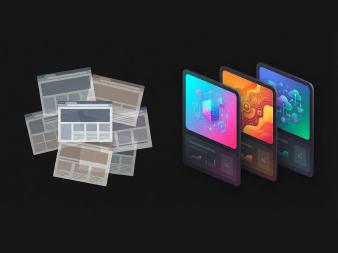
The internet was built on pages and copies. plugilo is built for something fundamentally different: a world of live, owner-controlled objects.
When information stops being static content and becomes dynamic, trusted, and continuously updated, the way we organize it must change as well. Traditional models like folders, bookmarks, or flat tagging systems are no longer sufficient. They were designed for files, not for living objects with ownership, relationships, and authority.
To function as a true network layer above the internet, plugilo combines seven complementary information-organization techniques. Each serves a distinct purpose, and together they form the foundation of a scalable, trust-first system.
1. Objects and Relationships, Not Files and Folders
At the core of plugilo is an object network. Every Card represents a real-world object such as a product, company, hotel, or service. These objects exist independently and are connected through explicit relationships like ownership, alternatives, compatibility, or location.
This graph-based structure defines objective reality in the system. It enables comparison, reasoning, explainability, and ecosystem-level navigation. Most importantly, it establishes a single canonical representation for each object.
2. Structured Attributes for Precision
Objects are more than nodes in a graph. They are defined by structured attributes governed by clear schemas.
Specifications, availability, pricing, features, and certifications are all examples of attribute-based organization. This layer brings precision and machine-readability, enabling accurate filtering, comparison, and real-time updates. It is essential for enterprise integrations and for transforming unstructured data into live, trustworthy cards.
3. Semantic Tags as Facets, Not Containers
Tags still matter, but their role must be clearly defined. In plugilo, tags act as semantic facets rather than as containers.
They support discovery, filtering, and intuitive navigation, helping users understand what an object is about. However, they do not define ownership or structure. Tags complement structured data and relationships; they do not replace them.
4. Intent and Rules Create Dynamic Views
Users do not organize information by ownership. They organize it by intent.
In plugilo, Stacks are best understood as rule-based views over the object network. A Stack might represent a wishlist, a comparison set, a project, or a travel plan. Technically, it functions like a saved query that combines intent, context, filters, and trust thresholds.
Because Stacks are views rather than containers, a single Card can appear in multiple Stacks at the same time without duplication. This reflects how people actually think and plan.
5. Time and Lifecycle Turn Content into Live Feeds
Objects change over time. Products launch, offers expire, specifications update, and certifications evolve.
Time- and lifecycle-based organization allows plugilo to surface what is new, what has changed, and what is no longer relevant. Cards become subscribable, and information becomes something users follow, not just store. This shift from static pages to live streams is central to plugilo’s vision.
6. Trust and Authority as a Structural Dimension
Trust is not a label. It is a system property.
plugilo organizes information based on ownership, certification status, and verification level. The same object may exist as a user-generated card, an AI-enriched representation, or a fully owner-certified live card. Trust determines which data is prioritized, which answers are authoritative, and where the truth comes from.
This layer is what allows plugilo to replace internet noise with source-of-truth objects.
7. AI-Driven Similarity for Exploration
Finally, plugilo embraces AI-native organization through semantic similarity.
Vector-based representations allow the system to suggest related objects, enable cross-domain discovery, and support inspiration when explicit structure is missing. This layer is probabilistic and exploratory by design. It enhances navigation and discovery but never defines truth or authority.
From Content Chaos to an Object Network
No single organization technique can support a trusted, live information network on its own. plugilo deliberately combines object graphs, structured attributes, semantic facets, intent-based views, lifecycle awareness, trust layers, and AI-driven similarity.
Together, these seven techniques enable a new model of information: one where live objects replace static pages, ownership replaces duplication, and trust becomes the product.