
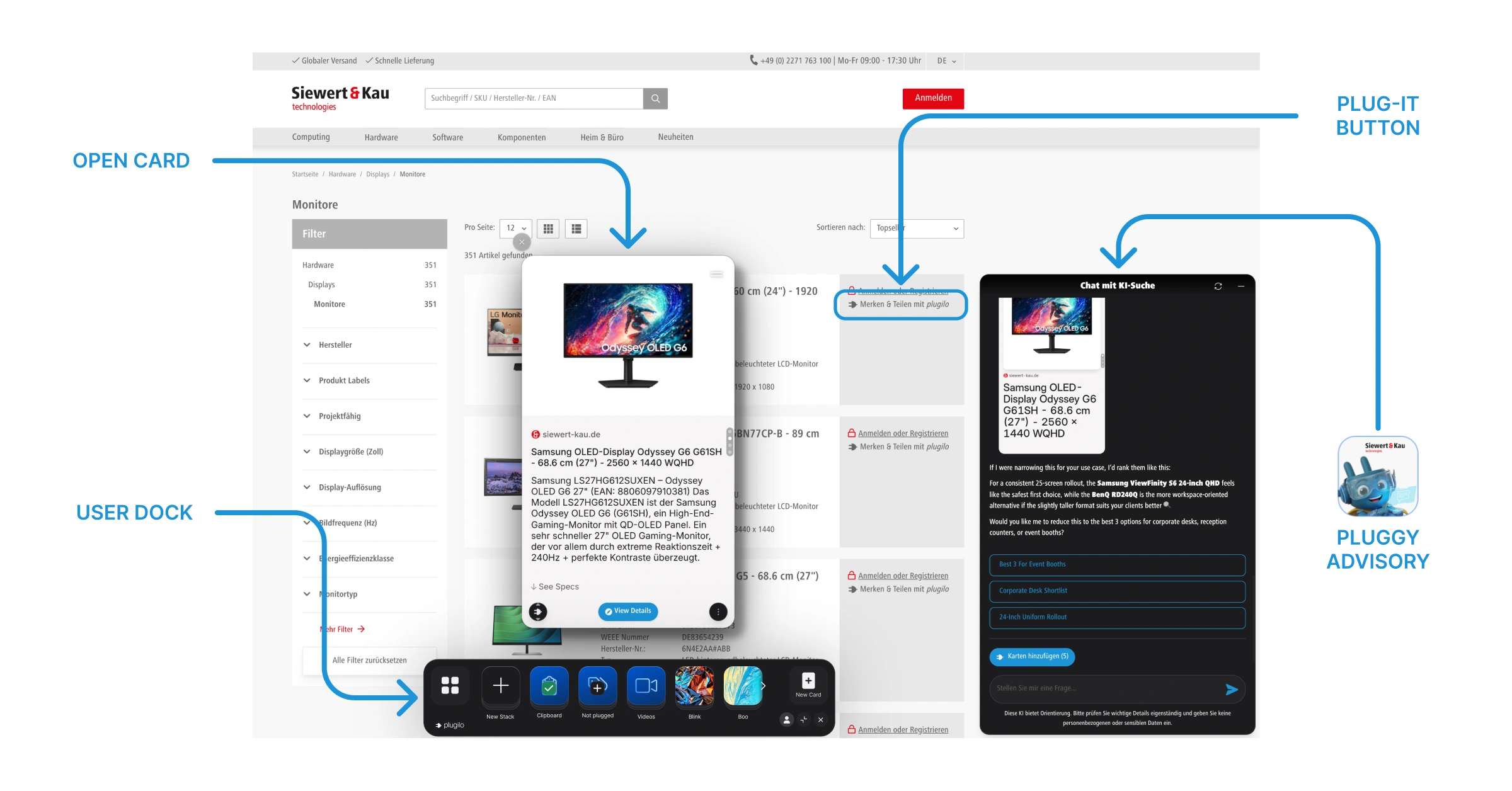
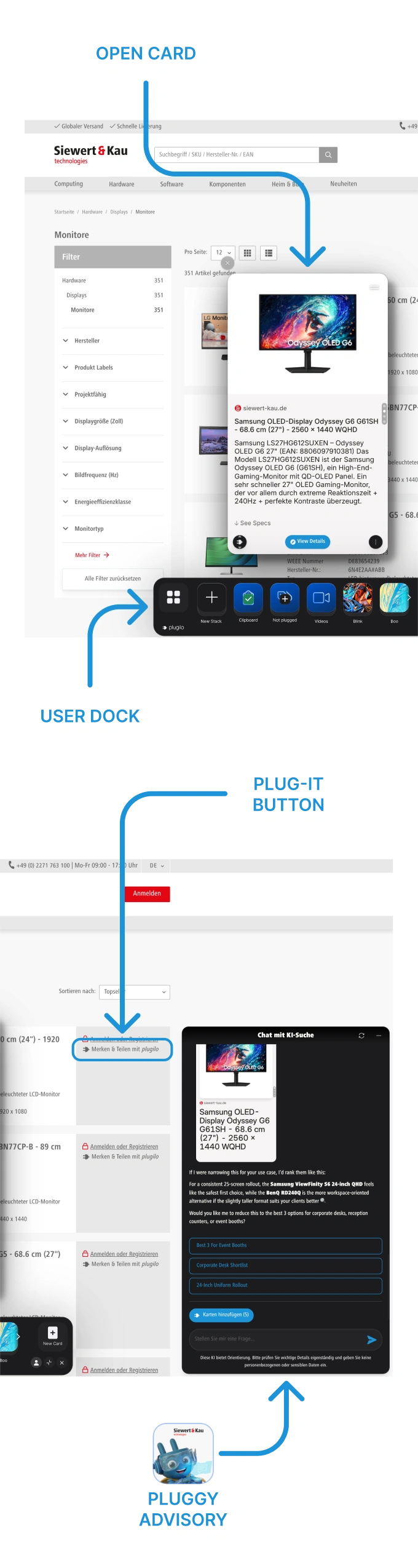
The web has too many isolated places to save things: bookmarks, wishlists, screenshots, open tabs, chat links, and notes. What feels relevant in the moment often gets lost later — or remains only as a bare URL without context. plug-it replaces that chaos with one simple, open mechanism: one click to save, then structured retrieval, clean sharing, and a direct path to keep working with it.
plug-it is not just a save feature. It is a connector, trigger system, UI symbol, overlay mechanism, routing layer, CTA logic, and entry point into the plugilo ecosystem all at once. That is the difference: plug-it does not simply save links. plug-it pulls content into a structured world of Cards & Stacks.
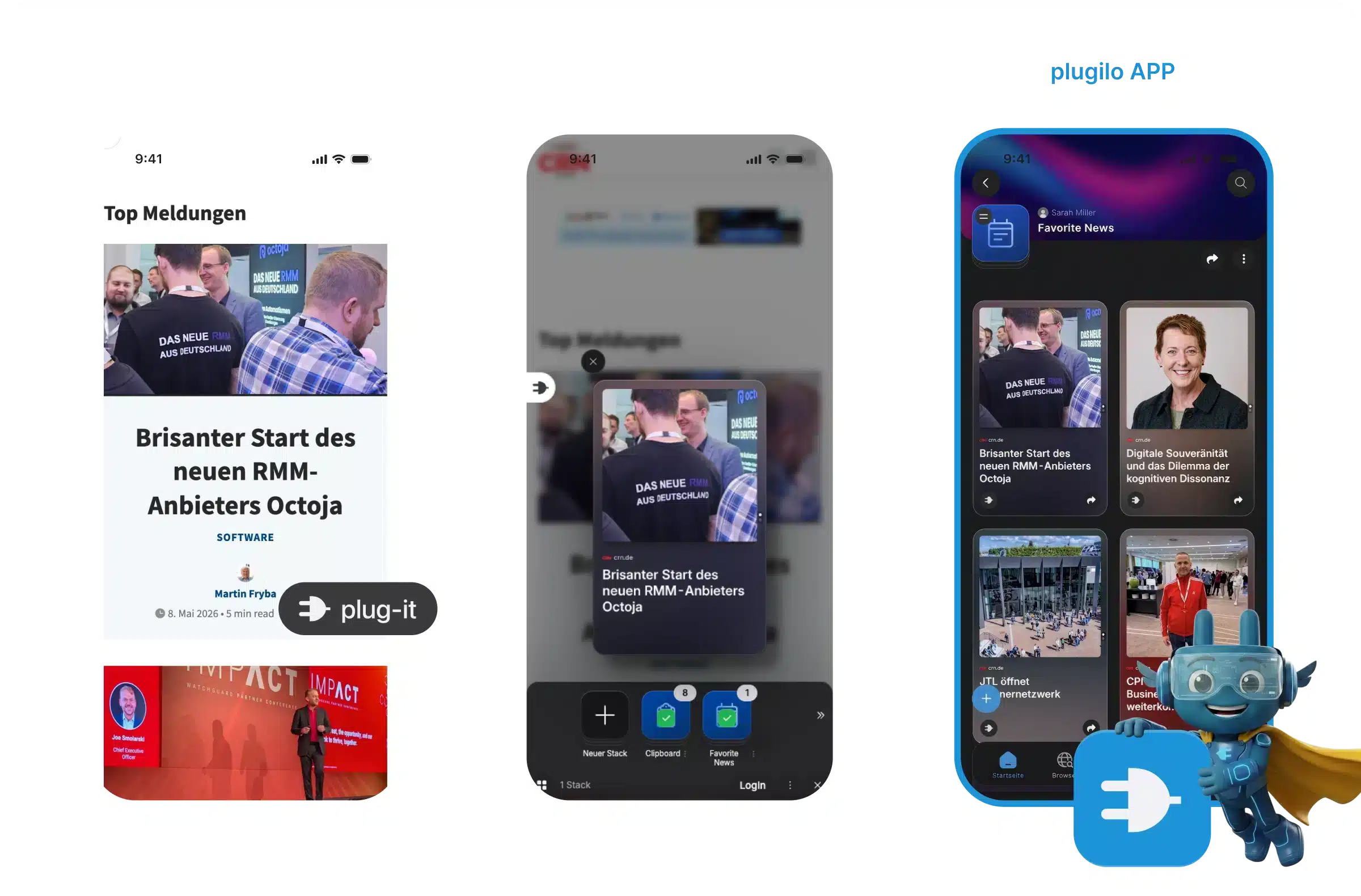

At the moment of relevance, everything has to feel easy. That is why plug-it is designed for minimal friction. The user clicks, saves, and gets more than a link — they get a structured Card with more context, more recognition, and better ways to find, organize, and share it later. A fleeting find becomes a usable object.
The real weakness of classic bookmarks and wishlists is not only that they live in silos. It is the lack of context. Later, people often no longer know why they saved something, what mattered about it, which source was the right one, or whether the information is still current. plug-it answers that with Cards instead of plain URLs, with structure instead of list chaos, and with later connections to Stacks, comparison, and sharing.
The plugilo plug is the visible sign of connection, context, and access. It can appear in front of brands, product names, SKUs, or other identifiers and open the matching Card or Stack on hover or click. It immediately signals: there is more context here. You can save here. This is where a clean information and sharing logic begins.
Over time, this access point extends beyond traditional websites — into QR and scan scenarios on products, posters, POS/POI materials, and other physical touchpoints. In this way, plug-it grows from a web element into a universal access point for structured information.
plug-it is deliberately designed as a lightweight, secure connector. The service can be rolled out as a JavaScript widget, a native shop or CMS integration, later through a browser extension, and across different partner environments. That creates no high entry barrier — only a fast path from the existing web into a more structured plugilo logic.
That is strategically important: plug-it does not demand a platform switch first. plug-it connects what already exists with a better save, information, and decision structure.
plug-it works contextually. Trigger logic can control when and where the plug appears — depending on language, URL, exclusions, terms, identifiers, or other rules. The user opens an overlay by click or hover, sees the Card or Stack, and can then save, organize, compare, share, and move to the next step.
This turns a static page element into an intelligent decision point. Not just information. But action with context.
plug-it is also a routing and CTA layer. From the Card, defined paths can lead into the shop, to the manufacturer, to where-to-buy, to partners, affiliate targets, or campaign destinations. That makes plug-it commerce-ready, partner-ready, and channel-steerable.
The decisive advantage is this: the same save moment can also become an information moment, a purchase moment, a partner-routing moment, and an attribution touchpoint. plug-it does not just save. plug-it routes intelligently.
Classic wishlists are usually shop-bound, login-heavy, and hard to share. plug-it is designed as a universal, cross-site wishlist. Users do not move inside one single shop. They read, compare, discover, and decide across many sites and devices. That is exactly what plug-it is built for.
This turns many isolated save locations into one open, global save-and-share standard. Not only for consumers. Also for teams, B2B recommendations, projects, and shared decision-making.
The next logical step after saving is sharing. That is why plug-it leads not only into individual Cards, but into Stacks as a structured sharing unit. Instead of sending twelve links, screenshots, and chat messages, one clean, curated collection gets shared. This turns chaotic forwarding into a shared decision space.
That is where the brand promise becomes tangible:
plug it — save in one click.
love it — feel the clarity.
share it — send one Stack, not link chaos.
For users, plug-it means less chaos, more clarity, better retrieval, and cleaner sharing. For shops and resellers, it means better information, less maintenance effort, more context at the product, and a stronger decision surface. For OEMs, it means more data sovereignty and presence exactly where decisions happen. For publishers, it means content enrichment, stronger memorability, and new monetization logic.
This turns plug-it into more than a UX feature. It becomes a real partner product with value on multiple levels at once.
plug-it is the capture and connector layer of the plugilo ecosystem. This is where the first save moment begins. This is where fleeting content becomes a collectable object. This is where the path leads from an external website into Cards, Stacks, sharing, comparison, advisory, and further services.
That is exactly why plug-it is so strategically strong: it is the easiest entry point into a much bigger logic.
plug-it turns isolated save functions into an open standard for the web. A standard that does not only save content, but structures it, contextualizes it, makes it routable, and turns it into real decisions. Fast for users. Easy for partners. Powerful for the whole network.
What emerges is more than a better wishlist.
It is the save-and-connect infrastructure for websites, shops, content, and decisions.
See how plugilo structures, certifies, distributes, and makes information usable for AI.

Use certified data, trusted AI Advisory, and real intent signals to create more impact.
Become a Partner

Save, organize, compare, and share trusted Cards and curated Stacks.
Access plugilo portal: